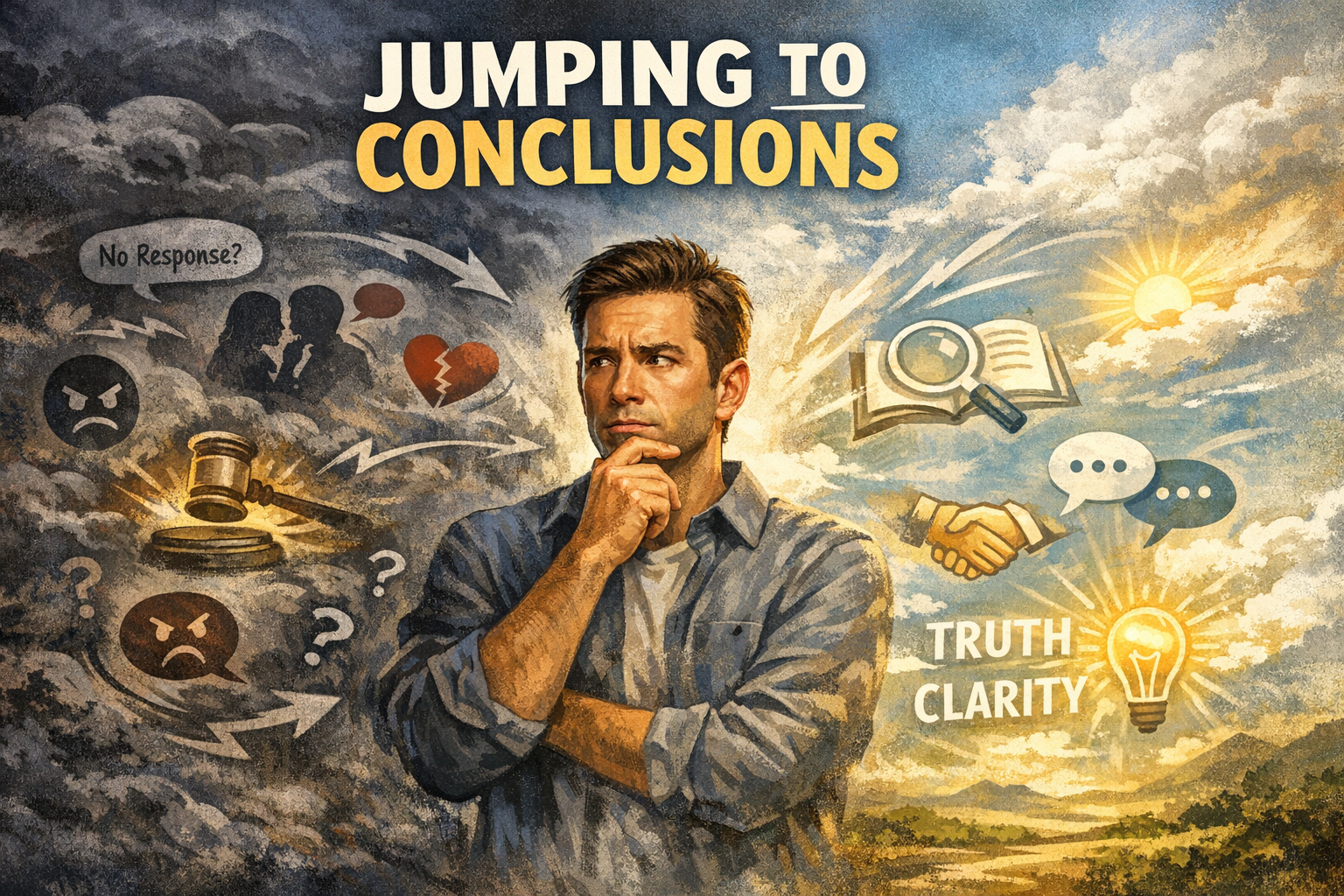
“Sometimes the story we tell ourselves becomes the storm we’re trying to survive.”
There are moments in life when our minds move faster than reality. Moments when a look, a tone, a delay, or a silence becomes a whole narrative we create in our heads. Moments when we assume the worst before we even know the facts. Moments when fear fills in the blanks that truth hasn’t spoken yet. This is what it means to jump to conclusions — to let imagination outrun information, to let emotion outrun evidence, to let insecurity outrun clarity. And the truth is, we’ve all done it. We’ve all built stories in our minds that had nothing to do with what was actually happening. We’ve all reacted to assumptions instead of reality. We’ve all let our thoughts run wild and then wondered why our peace disappeared.
Jumping to conclusions is one of the most human things we do, but it’s also one of the most damaging. It can ruin relationships, distort communication, and create emotional storms that didn’t need to exist. It can make us defensive when no one is attacking us, anxious when nothing is wrong, and angry over things that never even happened. It can turn small misunderstandings into big conflicts and simple moments into complicated battles. And the hardest part is that it often happens quietly — inside the mind, where no one else can see the war we’re fighting.
Most of the time, jumping to conclusions is rooted in fear. Fear of being hurt. Fear of being abandoned. Fear of being misunderstood. Fear of being rejected. Fear of repeating old wounds. When something triggers those fears — even slightly — the mind tries to protect us by preparing for the worst. It’s a survival instinct, but it often leads us into emotional chaos. Instead of asking questions, we assume answers. Instead of seeking clarity, we create confusion. Instead of giving people grace, we give them guilt. And instead of trusting God with the unknown, we fill the unknown with our own anxieties.
Sometimes we jump to conclusions because of past trauma. When you’ve been lied to before, you start expecting lies. When you’ve been betrayed before, you start expecting betrayal. When you’ve been abandoned before, you start expecting abandonment. The mind tries to protect you by predicting danger — even when danger isn’t there. But the problem is that the past can’t be the lens you use to judge the present. Not everyone is who hurt you. Not every situation is what broke you. Not every silence is rejection. Not every delay is disrespect. Not every disagreement is an attack. Sometimes the mind is reacting to old wounds, not current reality.
Other times, we jump to conclusions because we’re overwhelmed. When life is heavy, stress can distort perception. A simple text message can feel like an insult. A neutral expression can feel like judgment. A delayed response can feel like abandonment. A misunderstanding can feel like betrayal. When the mind is tired, it becomes more reactive. It fills in gaps with fear instead of truth. It interprets everything through the lens of exhaustion. And suddenly, everything feels personal — even when it isn’t.
But here’s the part we don’t talk about enough: jumping to conclusions doesn’t just affect how we see others — it affects how we see ourselves. When we assume the worst, we often assume the worst about us. We start believing we’re not enough, not valued, not wanted, not appreciated. We start believing lies about our worth because we’re interpreting situations through insecurity instead of identity. And that’s why this habit is so dangerous — it doesn’t just distort relationships; it distorts self‑perception.
The good news is that awareness is the first step toward change. When you start noticing how quickly your mind jumps to conclusions, you can begin to slow it down. You can pause before reacting. You can breathe before assuming. You can ask questions before creating stories. You can choose curiosity over fear. You can choose clarity over chaos. You can choose truth over imagination. And you can choose peace over panic.
One of the most powerful things you can do is challenge your thoughts. When your mind starts creating a negative narrative, ask yourself: “Do I know this for a fact, or am I assuming?” That one question can save you from unnecessary emotional storms. It can help you separate truth from fear, reality from imagination, facts from feelings. It can help you see situations more clearly and respond more calmly.
Another important step is communication. So many conflicts could be avoided if we simply asked instead of assumed. If we said, “Hey, can we talk about this?” instead of saying, “I already know what you meant.” If we said, “Help me understand,” instead of saying, “I know what you’re trying to do.” Communication brings clarity. Assumptions bring confusion. And clarity is one of the greatest gifts you can give yourself.
Grace also plays a huge role. When you give people the benefit of the doubt, you give yourself peace. When you assume good intentions instead of bad ones, you protect your heart from unnecessary hurt. When you choose compassion over suspicion, you create healthier relationships. Grace doesn’t mean ignoring red flags — it means not inventing them. It means letting people be human without punishing them for mistakes they haven’t made.
And then there’s faith — the anchor that keeps the mind from drifting into fear. When you trust God with what you don’t know, you stop trying to fill in the blanks with anxiety. When you trust His timing, you stop assuming delays are rejection. When you trust His protection, you stop assuming every situation is a threat. When you trust His love, you stop assuming the worst about yourself. Faith quiets the noise. Faith calms the mind. Faith reminds you that you don’t have to figure everything out — because God already has.
Jumping to conclusions is a habit, but habits can be broken. It takes practice. It takes patience. It takes self‑awareness. It takes humility. And it takes a willingness to slow down and let truth speak before fear does. But the more you practice it, the more peace you’ll experience. The more clarity you’ll gain. The more trust you’ll build. The more grounded you’ll become. And the more your relationships will flourish.
Imagine how different life would feel if you stopped assuming the worst. Imagine how much lighter your heart would be. Imagine how many conflicts would disappear. Imagine how much peace you would carry. Imagine how much love you could give and receive. Imagine how much closer you would feel to God when you stop letting fear write your story.
You deserve that peace. You deserve that clarity. You deserve that freedom. And it begins with one simple shift: choosing truth over assumption.
Scripture for Reflection:
“Everyone should be quick to listen, slow to speak and slow to become angry.” — James 1:19